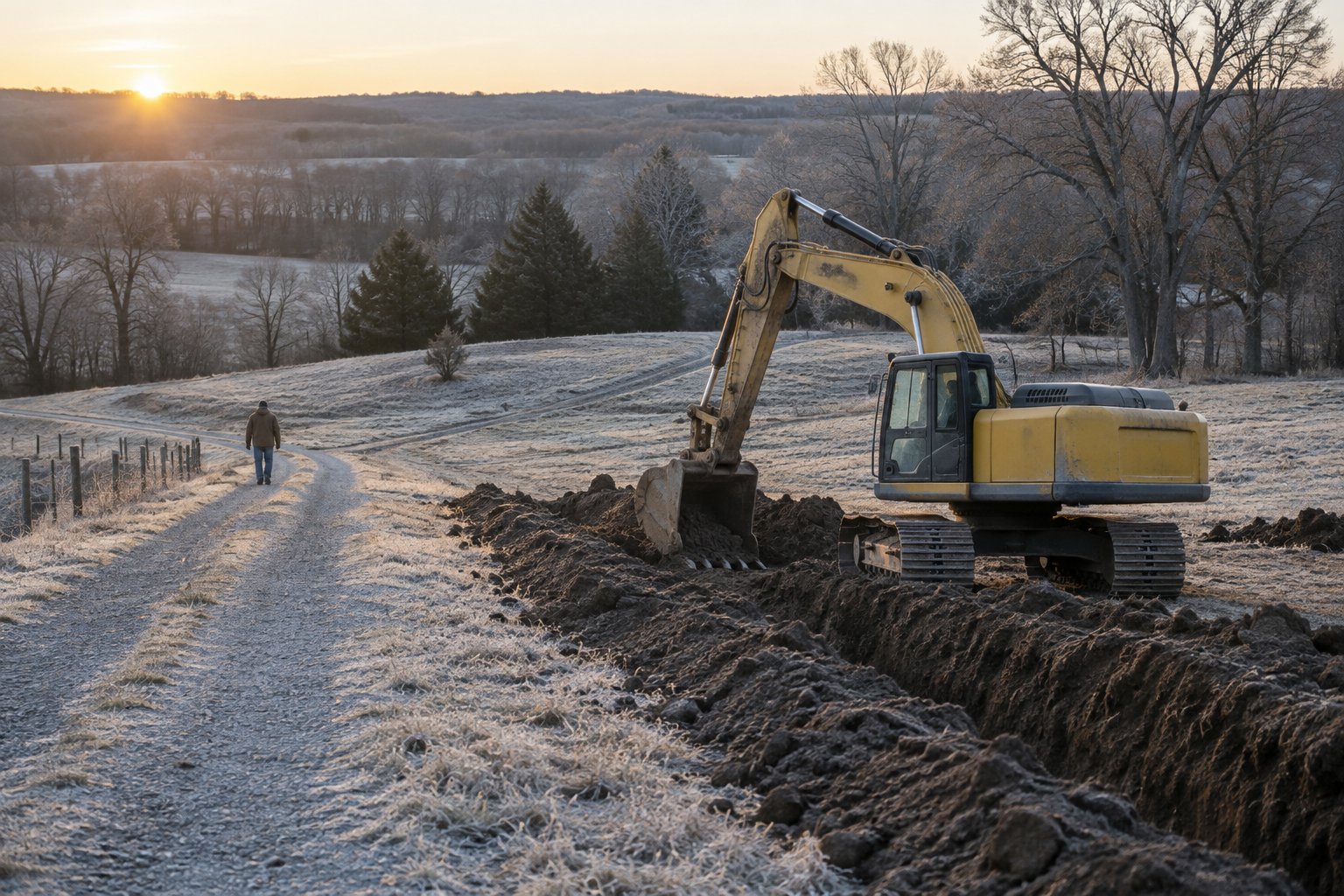
What Excavation Can Still Happen When Missouri Ground Freezes?
Every winter the same question comes up around Warrensburg, Holden, Knob Noster and the rest of Johnson County: if the ground is frozen, does all dirt work stop until spring? The honest answer is no, but it is not a simple yes either. Some excavation jobs go on through the cold months, some are better off waiting, and a few can only be done properly when the soil is soft and workable. Knowing which is which helps you plan, and helps you avoid paying for a rushed job that has to be redone.
How Deep Does the Ground Really Freeze in Johnson County?
Less than most people expect. The University of Missouri's state climatologist reviewed decades of soil temperature records from the university's research stations and found that in central Missouri the frost line at Columbia never reached the 20 inch depth in the records through 2010. Snow cover is a big part of the reason, because snow insulates the soil. The same write-up notes that frost can run much deeper when an arctic outbreak hits bare ground, citing a 1899 report of ground frozen two to three feet deep near Oregon, Missouri.
The 30-year climate normals for a weather station near Warrensburg add useful detail. In January the average daytime high is about 40 degrees Fahrenheit and the average overnight low is about 18. A typical January has roughly 28 nights at or below freezing, but only about 10 days when the temperature never climbs above freezing. In plain terms, our winters are mostly a cycle of hard freezes at night and softening by afternoon, with only occasional stretches when the ground stays locked up all day.
For building purposes, the Missouri Public Service Commission publishes a frost depth map for manufactured housing installers. It lists 15 inches for the band between Interstate 70 and Interstate 44, which covers Johnson County, and notes that local jurisdictions may require footings to go deeper. Some local codes do. The City of Belton in neighboring Cass County, for example, lists a 36 inch frost line depth in its adopted code table. The takeaway: footing depth is set by the code that applies to your address, so ask your city or county building authority rather than assuming a number.
Work That Usually Keeps Going in Cold Weather
A firm, frozen surface can actually help certain jobs. The Missouri Department of Conservation's timber harvest guidance says heavy work should be done when the soil is firm, to limit rutting, compaction and erosion. The same logic applies to clearing and hauling on a rural property: when mud season is over and the surface is hard, equipment travels across pasture and wooded ground with less damage.
- Brush, cedar and lot clearing. Bare hardwoods make it easier to see the property lines, fence rows and low spots, and firm ground limits rutting.
- Hauling and access work. Moving material across a field is easier on frozen ground than on saturated clay.
- Emergency repairs. A broken waterline or a frozen sewer line does not wait for spring. We offer emergency waterline repair and pipe jetting and thawing for exactly these situations.
- Planning and layout. Site walks, staking, estimates and permit paperwork can all be done in winter so the ground-breaking date is ready when conditions allow.
Work That Is Better Off Waiting
Some work depends on the condition of the soil itself, and frozen or saturated ground is not a good starting point.
Septic drain fields. Missouri's construction standards for on-site sewage systems say an absorption system installation shall not be made while the soil is wet or moist, because working wet soil smears and destroys its structure. University of Missouri Extension gives the same advice: build the absorption field when the soil is crumbly, never wet, since construction in wet soil causes puddling, smearing and compaction that reduces permeability and can contribute to system failure. Johnson County Community Health Services administers the onsite wastewater permits for new construction and modifications, so a septic project also needs that permit in hand before work starts.
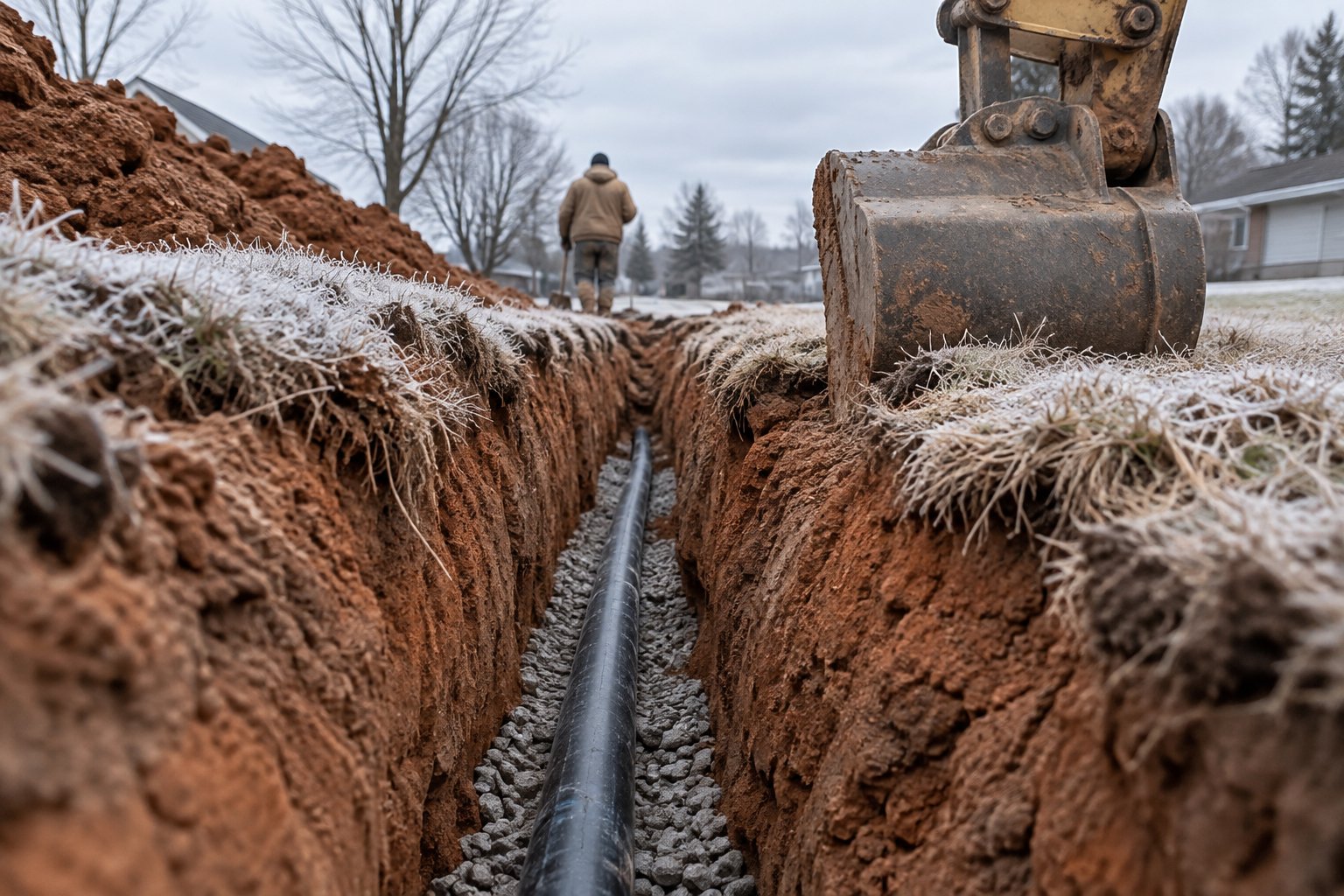
Pond dams. USDA NRCS practice specifications for ponds call for fill material that is free of sod, roots, frozen soil and large stones, placed in thin layers and compacted, and say fill should be built only when moisture content allows satisfactory compaction. A dam is the one place where cutting corners on cold-weather fill can show up years later as seepage.
Footings and foundations. Missouri's modular residential code, which is based on the International Residential Code, states that footings shall not bear on frozen soil unless the frozen condition is permanent. A foundation poured over frozen ground can settle when the soil thaws.
Concrete flatwork. The American Concrete Institute defines cold weather concreting as conditions where air temperature has fallen or is expected to fall below 40 degrees Fahrenheit during the protection period. Concrete can be placed in those conditions, but it needs protection from freezing and a properly prepared subgrade. Its standard specification warns that a frozen subgrade can lead to freezing of the new concrete or settlement when the subgrade thaws. For a driveway or patio, most homeowners are better served by a spring pour.
One Rule That Does Not Change in Winter: Call 811 First
Missouri law requires an excavator to notify the state's one-call center at least two working days, but not more than ten working days, before digging. Missouri 811 describes this as a three working day process when you count the day of the request, and says a ticket stays valid for 21 consecutive calendar days. Frost does not change those rules, and cold weather is no reason to skip the locate. Buried lines are just as present in January as in June.
How to Use the Cold Months Well
If you have excavation, septic or drainage work on your list for spring, winter is when the groundwork is done. Walk the property while the vegetation is down. Note where water pooled after the last rain or thaw. Mark the area where you want a pad, pond, driveway or drain field. Ask your septic contractor and the county health office what they need for a permit. Getting estimates and permits sorted in winter means the crew can start as soon as the soil is workable instead of competing for a spot at the front of the line.
A contractor who knows Johnson County soil can also tell you honestly which of your projects can move now and which should wait. That kind of straight answer is worth more than a promise to dig anything, anytime.
Frequently Asked Questions
Can you dig a trench when the ground is frozen?
Often yes, because frost in Missouri is usually shallow and the ground below it is workable. The practical issues are what the trench is for and what goes in it. A utility trench can be opened in cold weather, but ask your contractor how bedding, backfill and compaction will be handled in freezing temperatures. Whatever the project, a locate request to Missouri 811 comes first.
Can a septic tank or drain field be installed in winter?
It depends on the soil on the day. State standards say absorption systems should not be installed in wet or moist soil, and a permit is required through the local health authority. If conditions are not right, the drain field is usually better scheduled for when the soil is crumbly. Ask your installer what the site evaluation shows.
Is it a bad idea to pour concrete in winter?
Not automatically, but it requires cold weather protection, and the subgrade must not be frozen. Because a failed slab is expensive to remove, many Johnson County homeowners choose to prepare the base now and schedule the pour for milder weather.
Do I still need a locate if the ground is frozen?
Yes. Missouri law requires notifying the one-call center before excavating, regardless of the season.
If you are weighing a winter project against a spring one, contact us through our contact page and tell us about your property in Johnson County or the surrounding counties. We can walk through what is realistic now and what should wait, and request a quote so your schedule is set before the ground thaws.
